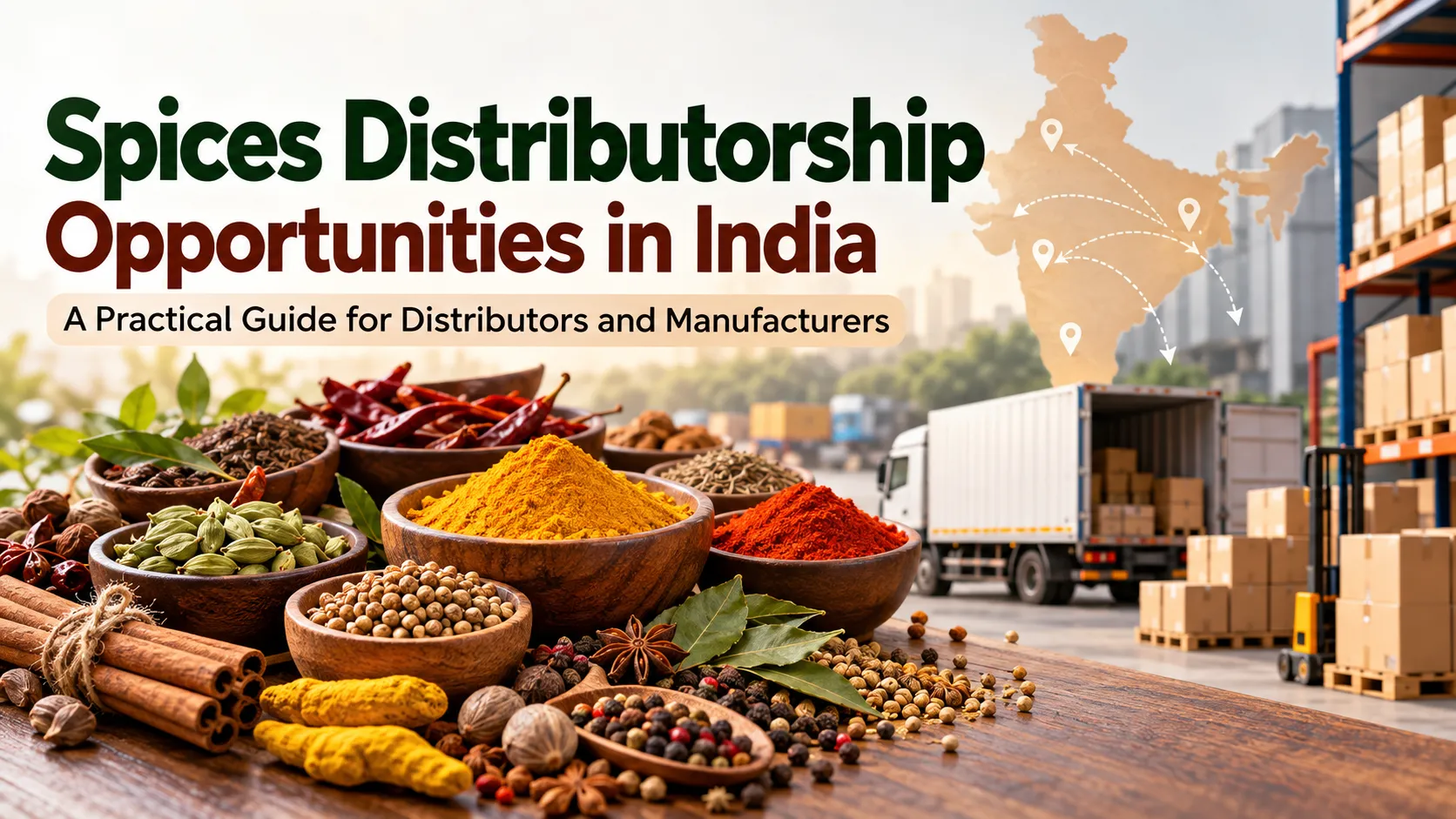
Spices Distributorship in India
Spices Distributorship in India: Opportunities, Business Guide, and How to Find Distributors
Indian kitchens use spices every day. Turmeric, chilli, coriander, cumin, and ready-made masala blends are bought again and again, and they sell through grocery stores, supermarkets, and wholesale markets in every city. That steady, repeat buying is why many entrepreneurs and existing FMCG distributors look at a spices distributorship as a business option.
In short, a spice distributorship is an arrangement where a distributor buys packed spices or masalas from a manufacturer or brand and supplies them to retailers and wholesalers in an agreed territory. The distributor earns a margin and takes on the work of stocking, delivery, collections, and relationship-building.
This guide explains how the model works, how to start, how to judge a spice manufacturer, and how manufacturers can find reliable distributors. It does not promise profits. Results depend on your territory, competition, working capital, and how well you execute.
What Is a Spices Distributorship?
A spice distributorship is a business arrangement where a distributor is authorized to sell a spice manufacturer’s or brand’s products in a defined area. The manufacturer focuses on sourcing, processing, packing, and branding. The distributor focuses on getting those products onto shelves.
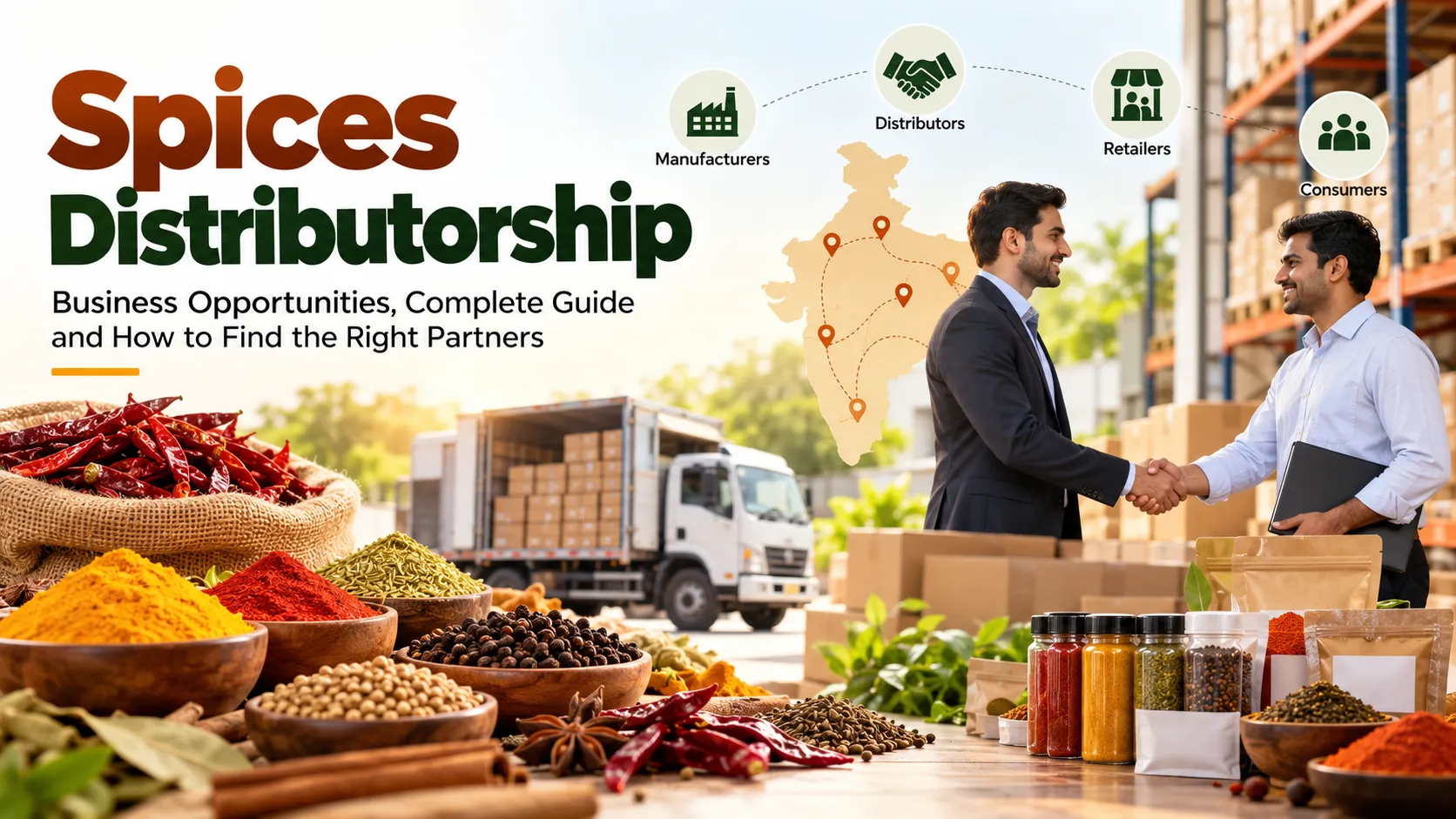
A typical spice distribution chain looks like this:
- Spice manufacturer or brand: produces and packs the products.
- Distributor: buys in bulk from the manufacturer, holds stock, and supplies a territory.
- Wholesaler or sub-distributor: buys from the distributor and supplies smaller shops.
- Retailer: kirana stores, supermarkets, and general stores that sell to customers.
- Customer: the household or institutional buyer.
People often mix up these roles, so here is the simple difference:
- A distributor usually has an agreement with the manufacturer and exclusive or defined territory rights.
- A dealer often sells in a smaller area and may buy from a distributor.
- A wholesaler sells in large quantities to retailers and may carry many brands.
- A retailer sells directly to the end customer.
Why Consider a Spices Distributorship Business in India?
Spices and masalas are everyday purchases, so demand is regular rather than seasonal. This makes a spice distribution business attractive for people who want repeat orders instead of one-time sales.
Here is where the opportunity usually comes from:
- Repeat buying: shops reorder fast-moving packs often.
- Portfolio fit: an existing FMCG distributor already has retailer relationships and can add spices to the same delivery route.
- Many buyer types: grocery retailers, supermarkets, wholesalers, and sometimes institutional buyers such as caterers.
- Regional taste: local masala brands can do well in areas where national brands are weaker.
Be realistic, though. Spices are a crowded category. Your results will depend on four things: local demand, competition from established brands, distribution costs, and how much money is locked in stock and unpaid bills. A good-looking brand does not guarantee sales in your area.
How to Start a Spices Distributorship Business
Follow these steps in order. Do not skip the research.
- Research local demand and competition. Visit retailers and wholesalers in your target area. Note which brands sit on the shelves, which packs move fast and what shop owners complain about.
- Identify suitable spice manufacturers and brands. Shortlist several, not one. Compare at least three before you commit.
- Evaluate quality, packaging, pricing and margins. Ask for samples. Check pack sizes, labelling and the margin you actually keep after transport and losses.
- Understand territory rights and terms. Ask about exclusivity, minimum order quantity, targets and what happens if you miss them.
- Estimate investment and working capital. Count stock, a delivery vehicle, storage, staff, and the credit you will extend to shops. There is no single correct amount. It changes with territory size and the number of brands you carry.
- Complete legal compliance. This usually includes business registration, GST registration where applicable, and FSSAI registration or licence. See the note below.
- Build retailer and wholesaler relationships. Start with a small group of reliable shops and expand gradually.
- Plan logistics. Decide how you will store stock, deliver, collect payments and handle repeat orders.
- Build a steady customer acquisition plan. Set weekly visit routes and follow-up schedules instead of relying on walk-in orders.
Licence note (verify before you apply): FSSAI changed its turnover limits from 1 April 2026. Under the FSSAI order dated 13 March 2026, basic registration applies up to ₹1.5 crore annual turnover, a state licence applies above ₹1.5 crore and up to ₹50 crore, and a central licence applies above ₹50 crore. Some activities need a central licence regardless of turnover. Always confirm the current rules on the FSSAI website or FoSCoS portal, or with a compliance professional, because your category depends on your exact activity.
How to Choose the Right Spice Manufacturer for Distributorship
Your manufacturer decides much of your success. A weak partner can leave you with slow stock and disputes. Check these points before signing anything:
- Product quality and consistency: taste, aroma and colour should be the same batch after batch.
- Brand reputation and positioning: is the brand known in your area, or will you build awareness from zero?
- Product range and packaging: a range of pack sizes helps you serve both small shops and bulk buyers.
- Pricing and real margins: ask for the full price list and calculate your margin after freight, damage and credit.
- Supply reliability: can the manufacturer fulfil orders on time, every time?
- Shelf life and storage: spices lose quality with moisture and heat. Know the shelf life and storage needs.
- Licences and food-safety compliance: ask to see the manufacturer’s FSSAI licence and verify the number.
- Marketing support: posters, samples, schemes, and shop display material.
- Written agreement: territory, targets, termination, and exclusivity should all be on paper.
- Returns, damage, and payment terms: know who bears the loss for damaged or expired goods and how long you get to pay.
How Can Spice Manufacturers Find Distributors in India?
Spice manufacturers often start with local sales and then struggle to enter new cities. Their problem is usually not the product, but finding trustworthy partners who already serve the right retailers.
A manufacturer who wants to grow into new regions can:
- Decide which cities and states to enter first, based on demand and logistics.
- Look for distributors who already handle FMCG or food products and have retail reach.
- Prepare a clear catalogue with product range, pack sizes, pricing structure, and distributor terms.
- Set transparent rules for territory, targets, and support so serious distributors can evaluate the offer quickly.
- Build a structured distributor network for manufacturers, where each partner has a defined area and clear responsibilities.
- Use digital channels for visibility alongside traditional trade relationships such as trade visits, exhibitions, and referrals.
Digital discovery does not replace relationships. It shortens the time needed to find and shortlist the right people, and the final decision still comes from conversations, samples, and references.
How GrowDistributors Helps Spice Manufacturers and Distributors
GrowDistributors.com is a B2B platform designed to help manufacturers, brands, and distributors discover relevant business opportunities and connect for distribution growth. GrowDistributors aims to make manufacturer and distributor discovery easier through a dedicated B2B distribution platform.
For spice manufacturers and brands, the platform can help you:
- Improve online visibility for your brand and products.
- Present your business and product information to prospective distributors.
- Discover distributor opportunities that match your target regions.
- Support expansion into additional markets.
- Build a more structured distributor recruitment process.
For distributors, the platform can help you:
- Discover brands and products that may suit your market.
- Explore distributorship and FMCG distribution opportunities.
- Evaluate manufacturers and product categories side by side.
- Expand your existing distribution portfolio.
- Explore new business relationships.
As a growing distributor platform, GrowDistributors works as a meeting point, not a guarantee. It does not promise leads, confirmed partnerships, or sales. You still need to verify products, terms and compliance before you agree to anything.
Next step: Manufacturers can list their brand and explore distributor opportunities, and distributors can browse available distributorship opportunities at GrowDistributors.com.
Spices Distributorship vs Other FMCG Distributorship Opportunities
Spices sit inside the wider FMCG distributorship space, but each category works differently. Here is how they compare in practical terms:
- Demand and customers: Spices are daily-use food items sold mainly through grocery and general stores. Other FMCG categories, such as soaps, snacks, or beverages, have their own buyer patterns.
- Storage: Spices need dry, clean storage and attention to expiry dates. Some other food and beverage categories need more space or temperature care.
- Competition and pricing: spices have many national and regional brands, so margins and schemes vary widely. Check each category separately.
- Portfolio diversification: an FMCG distributor who carries complementary products, such as masalas, pulses, or packaged staples, can use one delivery route to serve the same retailers.
- Separate categories: furniture distributorship is a different kind of business altogether. It involves bulky, higher-value, non-food products, longer sales cycles, and showroom or delivery logistics. It has no food-safety licensing, shelf life, or daily-reorder pattern like spices. It is mentioned here only to show how wide the B2B distribution market is.
Do not assume the investment, storage or compliance needs of one category apply to another. Evaluate each distributorship opportunity on its own facts.
Common Mistakes to Avoid in a Spices Distributorship Business
- Choosing a brand without research. Check quality, reputation and local demand first.
- Ignoring local competition. Established brands already own shelf space.
- Overestimating sales or margins. Base your plan on cautious numbers.
- Over-investing in slow-moving stock. Start with fast-moving packs and expand slowly.
- Ignoring expiry dates and storage. Spoiled or expired stock is a direct loss.
- Ignoring payment cycles. Many shops buy on credit. Slow collections can drain working capital.
- Depending on a single customer or supplier. One lost relationship should not stop your business.
- Signing agreements without understanding them. Read territory, target and termination clauses carefully.
- Neglecting retailer relationships. Consistent visits and reliable delivery keep repeat orders coming.
How to Find the Right Spices Distributorship Opportunities
Start by listing the brands that interest you, then compare them on the same checklist: quality, margin, territory, support, payment terms and compliance. Speak to existing distributors of the brand where possible, and ask for samples before you commit money.
You can find opportunities through trade exhibitions, wholesale market contacts, direct approaches to manufacturers and online B2B platforms. GrowDistributors is one place to explore manufacturer and distributor connections in one place, which makes shortlisting easier.
A practical next step: write down your target territory and budget, shortlist three to five spice brands, and request their distributor terms before making any payment.
Frequently Asked Questions About Spices Distributorship
What is spices distributorship in India?
Spices distributorship in India is an arrangement where a distributor is authorised by a spice manufacturer or brand to buy its products and sell them to retailers and wholesalers in a defined territory. The distributor handles stocking, delivery and collections, and earns a margin on sales.
How can I start a spices distributorship business?
Start by researching local demand and competition, then shortlist spice manufacturers, compare their terms, estimate your working capital, complete the required registrations and build a base of retailer relationships. The detailed steps are listed in the guide above.
How much investment is required for a spices distributorship?
There is no fixed amount, because investment depends on your territory, the brands you carry, stock levels, transport, storage and the credit you offer to shops. Ask each manufacturer for its distributor terms and calculate your own working capital before committing.
How do I find spice manufacturers offering distributorship?
You can approach brands directly, visit food and FMCG trade exhibitions, ask existing distributors, or explore B2B platforms such as GrowDistributors.com that connect manufacturers and distributors. Always verify the manufacturer’s licences and terms before paying anything.
Is FMCG distributorship a suitable option for existing distributors?
FMCG distributorship can suit existing distributors who already have retailer relationships and delivery routes, because they can add complementary products to the same network. It still needs checking for storage, competition, margins and working capital in each category.
How can spice manufacturers find distributors in India?
Spice manufacturers can find distributors by choosing target regions, preparing a clear catalogue and distributor terms, approaching FMCG and food distributors, and using trade contacts together with B2B platforms such as GrowDistributors. A defined territory plan helps build a stronger distributor network.
What licences may be required for a spice distribution business?
A spice distribution business usually needs business registration, GST registration where applicable, and FSSAI registration or licence based on turnover and activity. From 1 April 2026, FSSAI basic registration covers turnover up to ₹1.5 crore. Confirm your exact category on the FSSAI website or with a compliance professional.
How can I evaluate profit margins in a spices distributorship?
Calculate your margin after subtracting freight, handling, damage, expiry losses, staff, storage and the cost of credit given to retailers. Compare the net figure across brands, and do not rely only on the margin percentage quoted by the manufacturer.
How does GrowDistributors help manufacturers and distributors?
GrowDistributors.com is a B2B platform where manufacturers and brands can present their products and look for distributors, while distributors can explore brands and distributorship opportunities. It supports discovery and connection, and does not guarantee leads, partnerships or sales.
Where can I explore spices distributorship opportunities online?
You can explore spices distributorship opportunities on B2B distribution platforms such as GrowDistributors.com, on manufacturer websites, and through trade directories. Compare terms and verify compliance before you commit.
Conclusion
A spices distributorship can be a practical business for people who prepare properly. The basics are simple: pick products that suit your market, evaluate manufacturers carefully, understand your real costs and build reliable relationships with retailers and wholesalers.
Manufacturers benefit from the same discipline. A clear catalogue, transparent terms and a structured distributor network make it easier to attract serious partners.
If you are a manufacturer looking for distributors, or a distributor looking for new products to carry, visit GrowDistributors.com to explore relevant B2B opportunities.