How to Find the Right Distributorship Opportunity in India in 2026
Starting a distribution business can be one of the practical ways to enter the B2B market without manufacturing products yourself. In 2026, manufacturers and emerging brands across India are actively looking to expand into new cities, states and retail markets.
This has created a growing number of distributorship opportunities for entrepreneurs, wholesalers, retailers and business owners who already have local market connections.
However, finding a distributorship is easy. Finding the right distributorship is the real challenge.
A product may look attractive on paper but fail because of low demand, poor margins, excessive competition, high minimum orders or weak manufacturer support.
So, how do you identify a genuine opportunity?
Let's break it down.
What Is a Distributorship Business?
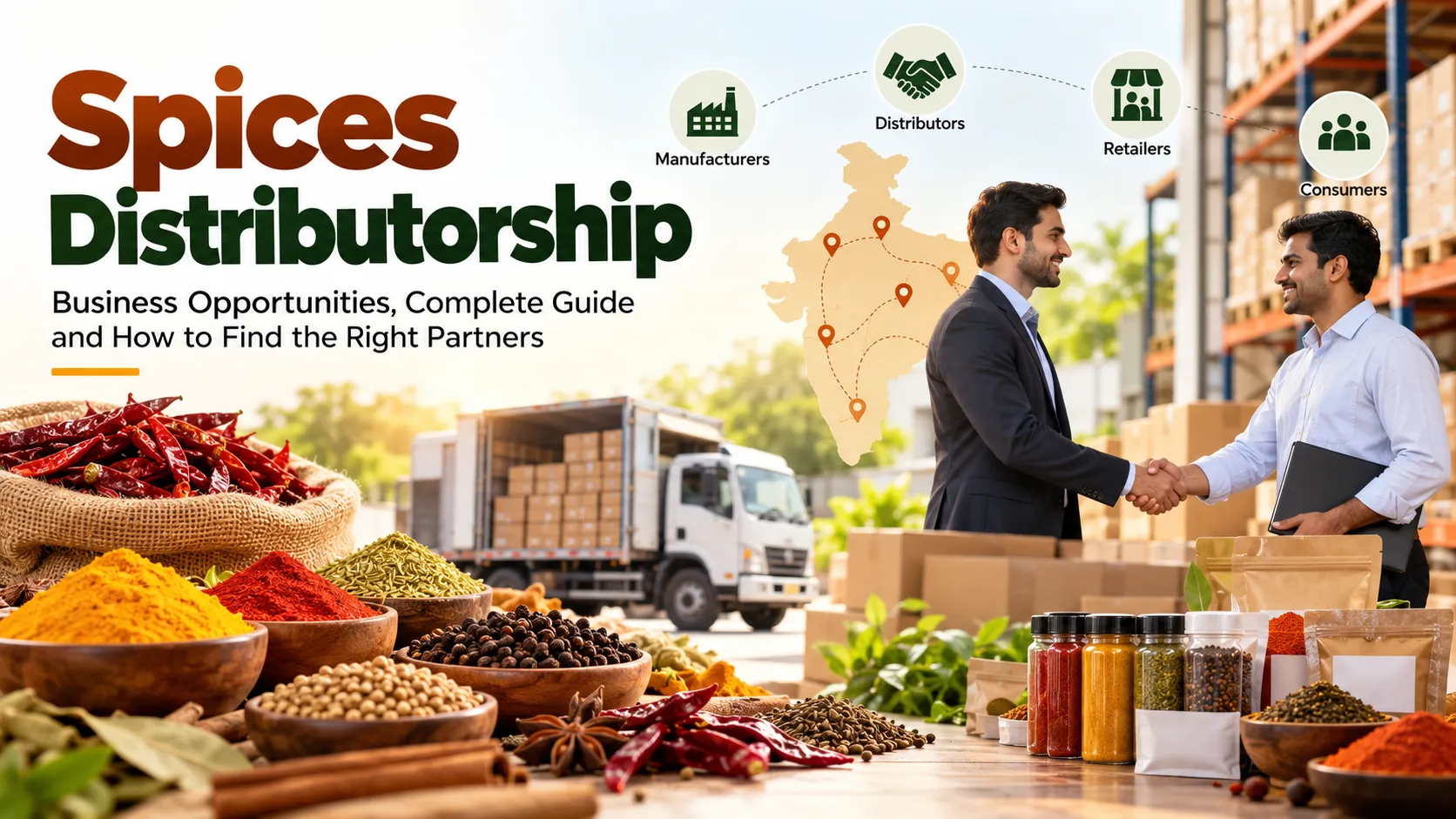
A distributor acts as a link between a manufacturer or brand and the market.
The basic business model is:
Manufacturer → Distributor → Dealer/Retailer → Customer
The manufacturer focuses on production and brand development, while the distributor helps move products into different markets.
Depending on the industry, a distributor may be responsible for:
- Maintaining inventory
- Developing retailer networks
- Supplying dealers
- Managing local sales
- Handling logistics
- Expanding the brand into new territories
- Collecting market feedback
The distributor generally earns through the margin between the purchase price and selling price.
Why Are Distributorship Opportunities Growing in India?
India's consumer and B2B markets are becoming increasingly diverse.
Brands are no longer focused only on metropolitan cities. Many manufacturers want to enter Tier 2, Tier 3 and smaller markets where demand is growing.
At the same time, new brands are entering categories such as FMCG, furniture, personal care, home products, agriculture and consumer goods.
But manufacturers cannot build distribution networks everywhere on their own.
This creates demand for local channel partners.
For entrepreneurs, this means there are more opportunities to explore than simply opening another traditional retail shop.
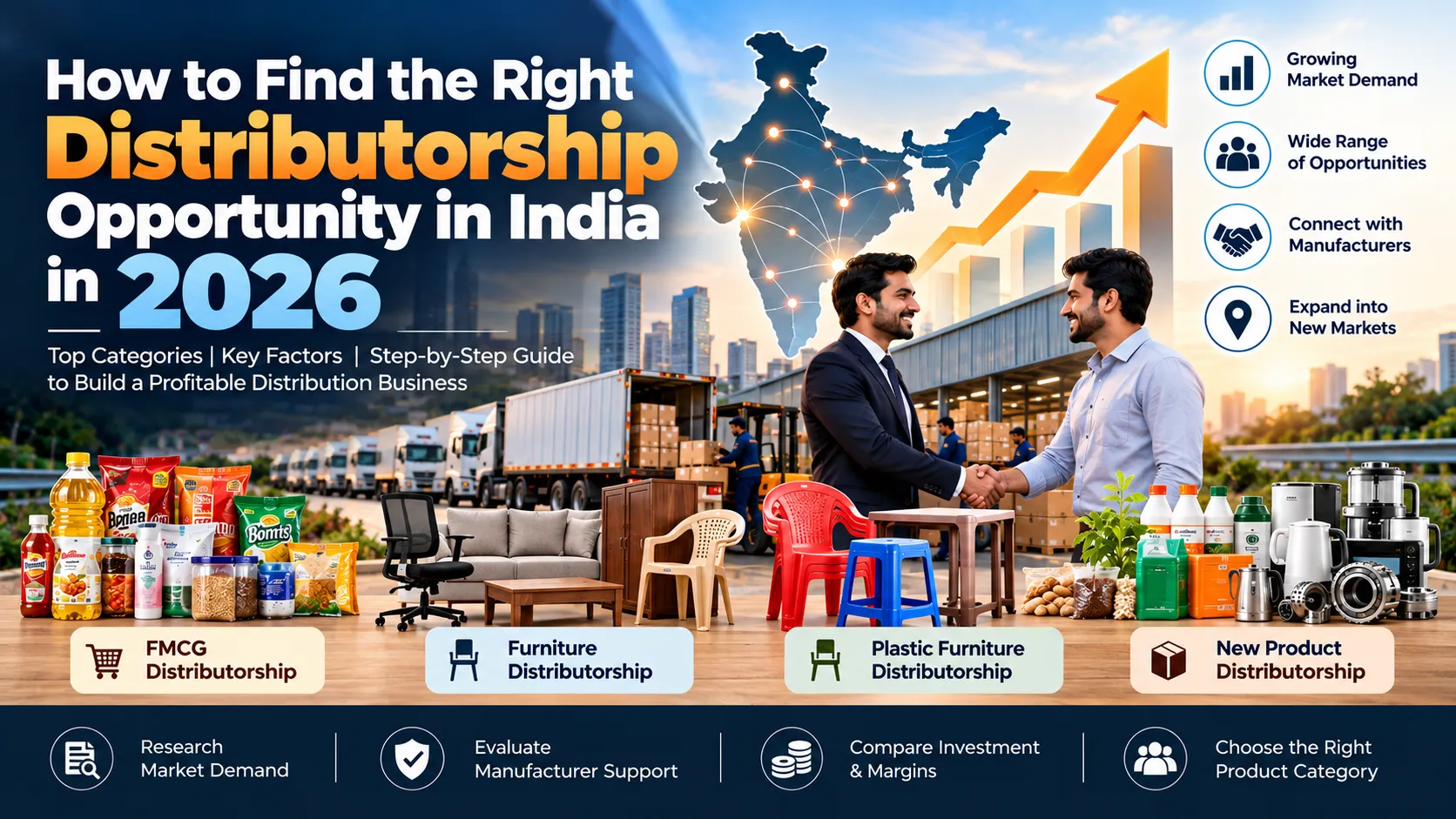
1. FMCG Distributorship
FMCG remains one of the most popular categories for distribution businesses.
Products such as spices, snacks, packaged food, beverages, household products and personal-care items have recurring demand.
This is why searches for FMCG distributor wanted and FMCG companies distributorship remain relevant for entrepreneurs looking to enter the distribution sector.
However, FMCG distribution can be highly competitive.
Before selecting a brand, check:
- Product demand in your area
- Retailer margins
- Distributor margins
- Competitor brands
- Product shelf life
- Minimum order quantity
- Delivery frequency
- Promotional support
A strong distribution network can be valuable, but the product must have enough demand to keep inventory moving.
2. Furniture Distributorship
Furniture is another category with significant B2B potential.
Residential construction, offices, schools, restaurants, hotels and commercial establishments all require furniture.
Entrepreneurs can explore furniture distributorship in categories such as:
- Office furniture
- Home furniture
- School furniture
- Institutional furniture
- Outdoor furniture
- Modular furniture
Furniture distribution may require more storage and logistics planning than FMCG, but the average order value can also be higher.
3. Plastic Furniture Distributorship
Plastic furniture distributorship is another opportunity worth exploring.
Plastic chairs, tables, stools and related products are used by households, restaurants, schools, event companies, offices and commercial establishments.
One advantage of this category is that products can serve multiple customer segments.
Before entering this market, however, distributors should evaluate:
- Product quality
- Wholesale pricing
- Transportation costs
- Storage requirements
- Local demand
- Competition
- Retailer margins
Don't choose a product simply because the manufacturer offers a high margin. A 30% margin on a product that doesn't sell is still a bad business.
4. New Product Distribution
New products can create some of the most interesting opportunities for distributors.
When a manufacturer launches a new product, it may not yet have distributors in every city.
This creates situations where:
Distributors required for new products
and
become genuine business requirements.
For a distributor, getting into a promising category early can provide an advantage because there may be less competition.
But new products also involve greater uncertainty.
Before investing, investigate the manufacturer, product quality, pricing, demand and marketing strategy.
How to Find Distributors Opportunities Online
Traditionally, finding manufacturers required personal references, trade exhibitions, newspaper advertisements or direct calling.
Today, entrepreneurs can use digital B2B platforms to discover companies and business opportunities more efficiently.
A distributor portal can bring manufacturers, brands, and potential distributors together in one place.
This is particularly useful for someone who knows they want to become a distributor but hasn't decided which product or company to work with.
Instead of searching for one manufacturer, entrepreneurs can explore multiple categories and compare different opportunities.
GrowDistributors: A B2B Platform for Distribution Opportunities
GrowDistributors is focused on connecting manufacturers, brands and distributors through a dedicated B2B ecosystem.
For manufacturers, the platform can help showcase products and distribution requirements to potential channel partners.
For entrepreneurs, it provides an avenue to discover companies looking for distributors across different categories.
Someone searching for:
wanted distributorship in India
FMCG distributor wanted
distributor opportunities
distributorship opportunities
or
distributors required for new products
can explore relevant business opportunities through a dedicated distribution-focused platform.
The goal is not simply to create another B2B marketplace. The bigger objective is to make manufacturer-distributor discovery easier.
What Makes a Good Distributor Portal?
There are many B2B websites online, but not every platform is equally useful for distributors.
A good distributor portal should make it easy to:
Discover Manufacturers
Users should be able to find brands and manufacturers across multiple product categories.
Explore Product Categories
Different distributors have different networks and expertise. Category-based discovery makes the search more efficient.
Find Distribution Requirements
Manufacturers should be able to clearly communicate where they require distributors and what type of partnership they are looking for.
Connect With Businesses
The process of sending an enquiry or contacting a company should be straightforward.
Compare Opportunities
Entrepreneurs should be able to research multiple companies before deciding where to invest.
How to Become a Distributor in 2026
If you're planning to become a distributor, don't start by putting money into inventory.
Start with research.
Step 1: Understand Your Local Market
Make a list of the retailers, wholesalers, dealers and businesses you already know.
Your existing network can help determine which categories are most suitable for you.
Step 2: Choose Your Category
Decide whether you want to explore FMCG, furniture, plastic furniture, agriculture, consumer products or another category.
Step 3: Find Potential Manufacturers
Use manufacturer websites, industry networks, exhibitions and B2B distributor platforms such as GrowDistributors.
Step 4: Compare Commercial Terms
Look at:
- Initial investment
- Minimum order quantity
- Distributor margin
- Credit period
- Territory rights
- Logistics
- Marketing support
Step 5: Verify the Company
Don't transfer money simply because a company promises high returns.
Check its products, business presence, customer feedback, registrations and market reputation.
Step 6: Test the Market
If possible, start with a manageable inventory level and evaluate actual demand before aggressively scaling.
How Much Investment Is Required?
There is no universal investment amount for a distributorship.
The requirement depends on the category, company, territory and business model.
For example, an FMCG distributor may require inventory, transportation and warehouse capacity.
A furniture distributor may require larger storage facilities and higher logistics spending.
An industrial product distributor may need technical knowledge and a different sales structure.
Therefore, the question shouldn't simply be:
“How much investment is required?”
A better question is:
“What return can I realistically generate on the capital I invest?”
Questions to Ask Before Taking a Distributorship
Before signing an agreement, ask the manufacturer:
- What is the minimum order quantity?
- What is the distributor margin?
- Is the territory exclusive?
- Are there existing distributors nearby?
- What marketing support is provided?
- What are the payment terms?
- How frequently can products be replenished?
- What happens to damaged products?
- What are the transportation costs?
- What sales targets are expected?
Getting clear answers can save you from expensive mistakes later.
Common Mistakes New Distributors Make
Many new entrepreneurs make the same mistakes.
Choosing Based Only on Margin
A high margin doesn't guarantee high profit.
Buying Too Much Inventory
Large inventory can lock up your working capital.
Ignoring Local Competition
A product may be successful nationally but struggle in your specific market.
Not Checking Manufacturer Support
A distributor needs reliable supply, communication and marketing support.
Chasing Every Opportunity
More opportunities don't necessarily mean better opportunities.
Choose businesses that match your network, capital and market.
The Role of Digital B2B Platforms in Distribution
The traditional distribution industry depended heavily on offline relationships.
Those relationships are still important, but digital discovery is making the initial connection easier.
A manufacturer in one state can now reach a potential distributor in another state without relying entirely on personal introductions.
Similarly, an entrepreneur can discover brands outside their existing network.
This is why specialised platforms such as GrowDistributors can become useful for both sides of the B2B ecosystem.
Final Thoughts
India's distribution market offers opportunities across FMCG, furniture, plastic furniture, consumer products, agriculture and many other categories.
But the goal shouldn't be to find any distributorship.
The goal should be to find a product with genuine demand, a reliable manufacturer, sustainable margins and a market where you can build a strong distribution network.
If you're searching for FMCG companies distributorship, furniture distributorship, plastic furniture distributorship, new-product distribution or other distributor opportunities, start by researching the market before investing.
Platforms such as GrowDistributors can help manufacturers and entrepreneurs discover each other and explore potential distribution partnerships.
In 2026, successful distribution isn't just about moving products.
It's about building the right network, choosing the right products and creating long-term value for both manufacturers and the market.