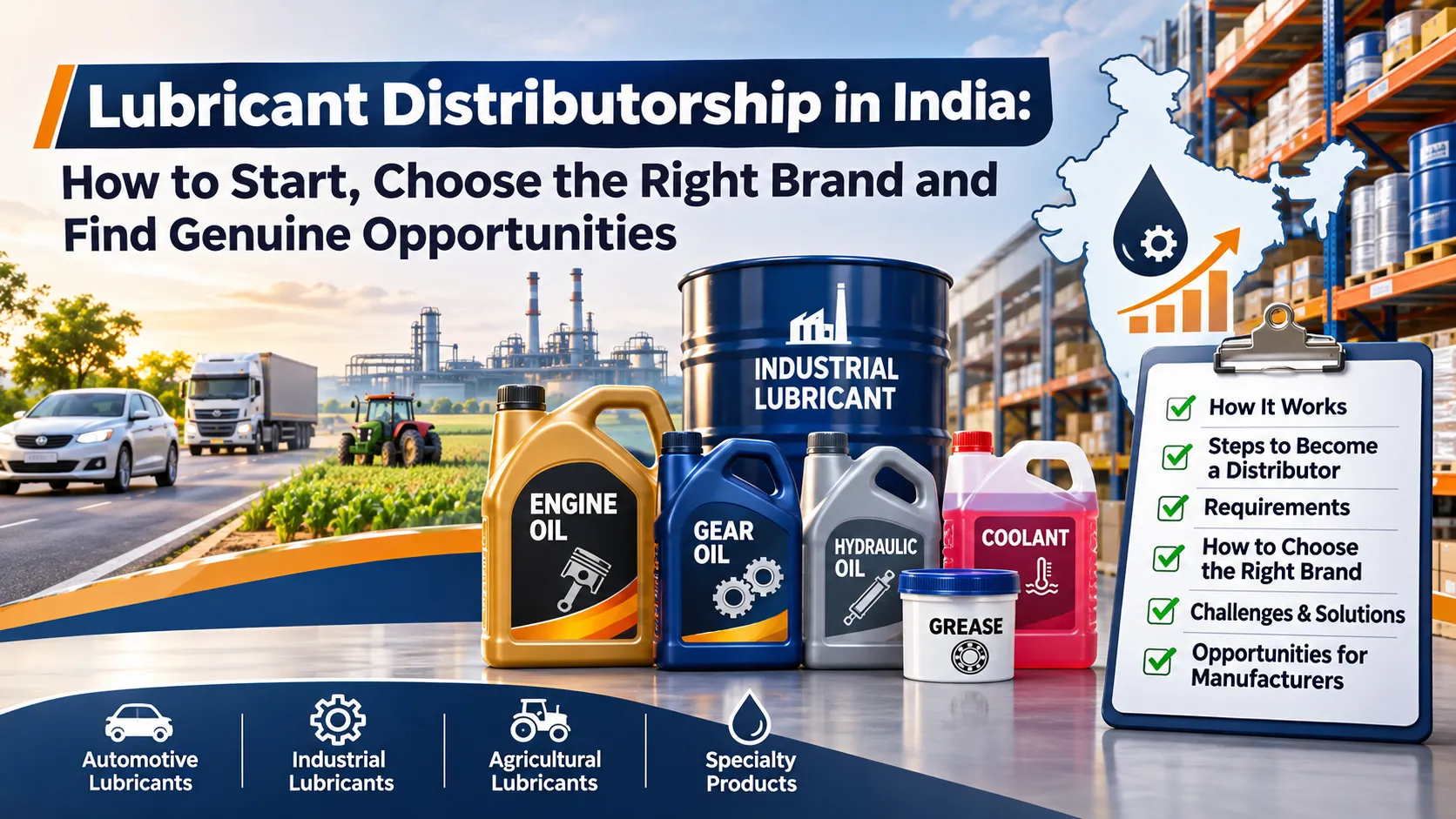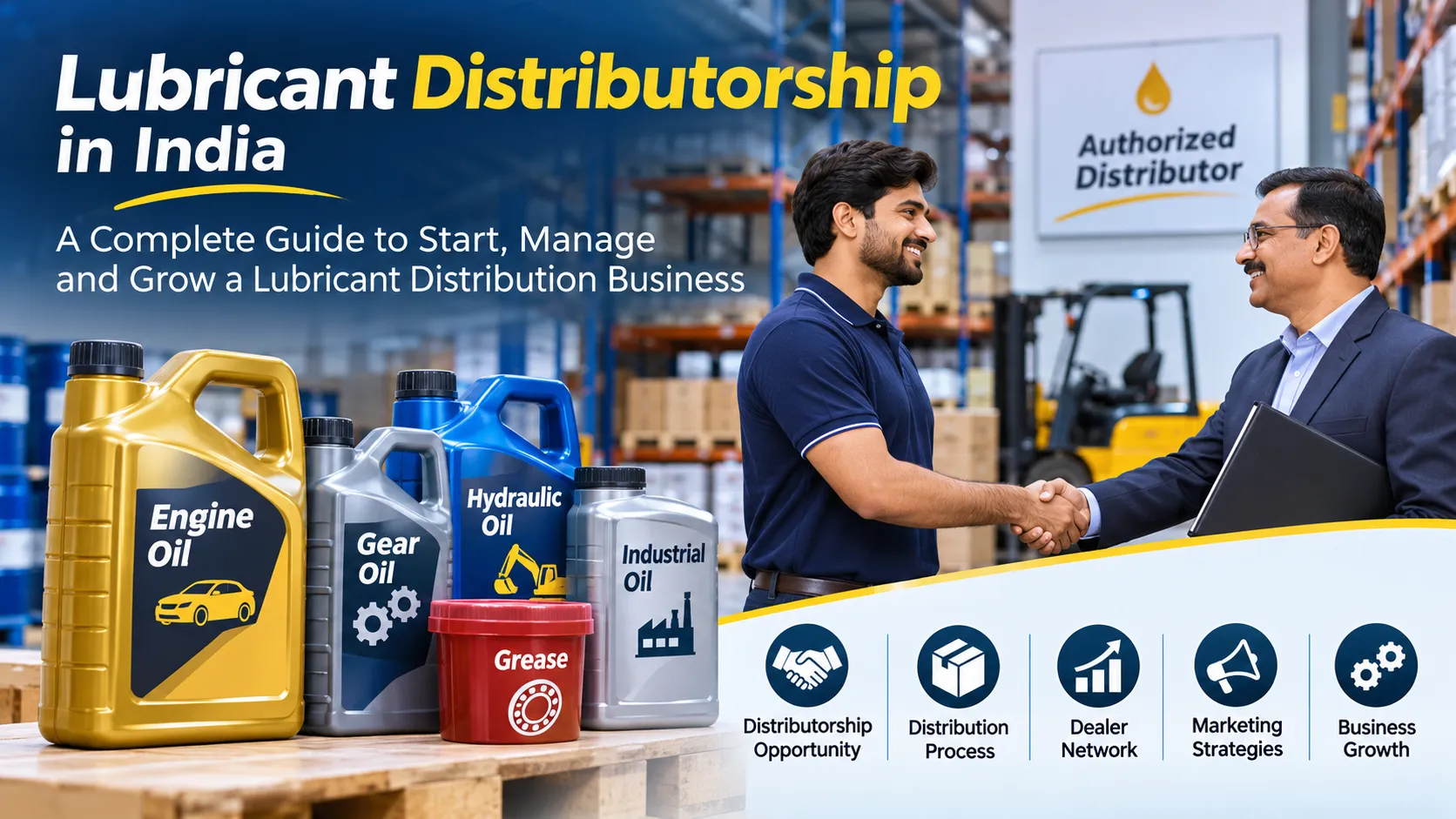
How to Start a Lubricant Distributorship in India: A Practical Guide
Lubricant distributorship is a steady business because every vehicle, machine and factory needs oil. But many people enter it with the wrong idea. They think the brand does the selling and they just hold stock. That is not how it works.
A distributor earns by managing territory, credit, stock, and relationships. A weak brand or a weak plan will hurt you quickly.
This guide explains how the lubricant distribution business works in India, how to become a distributor, and how to check whether an opportunity is genuine.
What Is Lubricant Distributorship?
Lubricant distributorship is a business arrangement where a manufacturer or brand gives you the right to buy its lubricants in bulk and sell them to dealers, retailers, workshops or industrial buyers in a fixed area.
Key points:
- You are the link between the manufacturer and the market.
- You usually get a defined territory.
- You buy at distributor rates and sell at a margin set by the brand’s pricing structure.
- You are responsible for stock, delivery, collections, and local sales.
How Does the Lubricant Distribution Ecosystem Work in India?
The chain usually looks like this:
- Manufacturer or brand owner: blends or sources oil, builds the brand, sets pricing and policies.
- Distributor or lubricant distribution company: holds stock, serves a territory, manages dealers.
- Dealer or lubricant dealership: buys from the distributor and sells to shops and customers.
- Retailer, garage, workshop, mechanic: sells or applies the oil.
- End user: vehicle owner, fleet, factory, or farm.
Some brands skip layers. A brand may sell directly to large industrial buyers and use distributors only for smaller customers. Ask any brand how it handles this, because direct sales can reduce your own business.
Dealer vs Wholesaler vs Distributor: What Is the Difference?
| Role | Buys From | Sells To | Typical Scale | Main Job |
|---|---|---|---|---|
| Distributor | Manufacturer | Dealers, wholesalers, large buyers | Largest | Territory management, stock, network building |
| Wholesaler | Distributor or manufacturer | Retailers, garages | Medium | Bulk trading in a local market |
| Dealer | Distributor | Retailers, workshops, end users | Smaller | Local sales and service |
| Retailer | Dealer or wholesaler | End users | Smallest | Counter sales |
The terms are used loosely in India. Always check the written agreement for what your role actually is.
What Types of Lubricants Can You Distribute?
Lubricants reduce friction, control heat, and protect moving parts. They fall mainly into automotive and industrial groups.
Automotive lubricants
- Engine oil: for cars, bikes, scooters, and trucks. This is the main volume product behind most engine oil distributorship opportunities.
- Gear oil and transmission fluid: for gearboxes and axles.
- Brake fluid and coolant: supporting products.
- Grease: for bearings and chassis points.
Industrial lubricants
- Hydraulic oil: for presses, excavators, machines.
- Compressor and turbine oil: for plants and power equipment.
- Metalworking fluids: for cutting and machining.
- Industrial greases and specialty oils: for specific machines.
Automotive vs Industrial: Which Suits You?
| Factor | Automotive Lubricant Distributor | Industrial Lubricant Distributor |
|---|---|---|
| Customers | Garages, retailers, fleets | Factories, workshops, plants |
| Buying pattern | Frequent, smaller orders | Less frequent, larger, planned orders |
| Sales style | Network and visibility driven | Relationship and technical-support driven |
| Credit risk | Spread across many buyers | Concentrated in fewer large buyers |
| Product knowledge needed | Moderate | Higher |
Advisor view: Automotive is easier to start. Industrial can be more stable but needs technical credibility and patience.
How Does the Lubricant Distribution Business Work?
Your income depends on four things:
- Margin structure: the gap between your buying price and selling price, after your own costs.
- Rotation: how fast stock sells. Slow stock blocks your money.
- Collections: how quickly dealers pay you.
- Brand pull: whether customers ask for the brand or you must push it.
Common business models:
| Model | How It Works | Best For |
|---|---|---|
| Exclusive territory distributorship | One distributor per area | Serious, long-term operators |
| Non-exclusive distributorship | Several distributors in the same area | Those who can compete on service |
| Distributor with dealer sub-network | You appoint and manage dealers | Those with local relationships |
| Industrial direct-supply distributor | You sell to factories and fleets | Those with B2B or technical background |
A realistic scenario: A person in a mid-sized town takes an engine oil distributorship. They fill the warehouse but have no dealer relationships. Stock moves slowly, cash gets stuck, and the brand blames weak effort. The problem was not the product. It was that they never planned the dealer network first.
How to Become a Lubricant Distributor in India
You become a lubricant distributor by choosing a brand, checking its credibility, applying to the manufacturer, meeting its criteria, and signing a written agreement for your territory.
Steps:
- Decide your focus. Automotive, industrial, or both. Your contacts and background should guide this.
- Study your territory. Know the garages, fleets, transport hubs, industrial clusters and existing brands.
- Shortlist manufacturers. Look for brands that suit your market, not just brands that approach you fastest.
- Verify the brand. See the checklist below.
- Approach the manufacturer. Use their official channel. Present your territory knowledge, existing contacts and storage capacity.
- Discuss terms in writing. Pricing, targets, credit terms, territory, exclusivity, returns, exit.
- Complete registrations and paperwork. See the section below.
- Plan stock and dealers before first order. Start with stock you can realistically sell.
- Launch and track. Review dealer performance regularly.
What documents are generally required?
Requirements differ by brand. Typically brands ask for:
- Business registration proof
- PAN and GST registration
- Identity and address proof
- Premises or warehouse proof
- Bank details
- Basic business background
Important: These are general business practices, not a legal checklist. Each manufacturer sets its own requirements. Confirm legal and tax needs with a qualified CA or lawyer.
What compliance matters for lubricant distribution?
| Area | What To Do |
|---|---|
| GST and business registration | Register and invoice correctly. Confirm product classification with your CA. |
| Local trade and storage permissions | Check local municipal and fire safety rules for your premises. |
| Packaging and labelling | Confirm the brand meets packaged commodity and labelling rules. |
| Quality standards | Ask which standards and approvals the product meets. |
| Used oil responsibilities | India regulates used lubricating oil as hazardous waste. Producers selling lubricating oil have extended producer responsibility. Ask the brand about its used oil registration status. |
Blind spot to avoid: Most new distributors never ask about used oil rules. A brand that ignores this can create legal problems that reach you through the supply chain. Check with CPCB and a legal advisor.
How to Choose the Right Lubricant Manufacturer
Choose a manufacturer by checking whether it is real, whether its product is good, whether its terms are fair, and whether it will support you after you sign.
Brand evaluation checklist
| What To Check | Why It Matters | Red Flag |
|---|---|---|
| Company existence | Confirms a real business | No verifiable address, plant or registration |
| Plant or blending facility | Shows real production | Refuses visits or meetings |
| Product quality and approvals | Protects your reputation | No clarity on standards or specifications |
| Product range | Lets you serve more customers | Very narrow range, no growth plan |
| Brand demand in your area | Decides how hard selling will be | Nobody in the market knows the brand |
| Written agreement | Protects both sides | Verbal promises only |
| Support | Training, marketing material, technical help | “We will see later” |
| Exit terms | Allows you to leave without loss | Stock locked in, no return policy |
| Fees | Fair business practice | Heavy upfront “registration” or “security” demands with no stock or clear terms |
How can you identify genuine manufacturers?
- Ask for the registered company name and verify it independently.
- Visit the plant or office in person.
- Speak to existing distributors without the brand’s presence.
- Check product batch details and packaging quality.
- Search for the brand in the market. See who stocks it.
- Be careful with ads saying “distributor wanted urgently.” Urgency is a sales tactic. Genuine brands plan territory carefully.
Important Factors Before You Accept a Distributorship
- Territory size and quality: Large does not mean good. Check vehicle density, industrial activity and competition.
- Exclusivity: Know exactly what exclusive means in writing.
- Targets: Unrealistic targets can lead to termination.
- Credit terms: Know what you owe, and what you must collect.
- Storage: Oil needs clean, dry, safe storage. Plan for leaks, fire safety and handling.
- Working capital: Plan for slow months without panic.
- Pricing control: Understand whether the brand protects your margin or lets direct sales undercut you.
- Brand support: Marketing, mechanic meets, signage, technical guidance.
How Do You Build a Strong Lubricant Dealer Network?
You build a dealer network by starting with relationships you already have, giving dealers a reason to switch, and supporting them after the first order.
Practical approach:
- Map the market first. List garages, spare part shops, fuel outlets, transporters, and workshops.
- Start with trust. Approach people who already know you.
- Offer something real. Reliable delivery, fair credit, product knowledge, and a brand customers can trust.
- Help dealers sell. Give display material, product guidance, and mechanic training.
- Track performance. Remove dealers who never pay or never sell.
- Do not overextend credit. Poor collections destroy more distributors than weak sales do.
Mechanics and garage owners often influence what customers buy. A distributor who builds mechanic trust usually gets repeat business.
Marketing Strategies for Lubricant Distributors
- Mechanic engagement: Product demonstrations, small gatherings, honest technical answers.
- Fleet outreach: Direct visits to transport companies and bus operators.
- Industrial cold outreach: Visit factories with product data sheets and a clear support plan.
- Local visibility: Signage at dealers, branded display racks, vehicle branding.
- Digital presence: A simple business profile, WhatsApp catalogues, Google Business listing.
- Referral loops: Satisfied dealers refer others.
- Consistency: Regular visits matter more than one-time campaigns.
Common Challenges and Practical Solutions
| Challenge | Why It Happens | Practical Solution |
|---|---|---|
| Slow-moving stock | Wrong products or weak demand | Start small, stock fast movers, review monthly |
| Late payments | Too much credit to weak dealers | Set credit limits, track dues weekly |
| Competition from big brands | Strong brand awareness | Compete on service, availability and relationships |
| Counterfeit or duplicate products in the market | Popular brands are copied | Educate dealers, use genuine supply, report fakes to the brand |
| Price undercutting | Other distributors or direct sales | Get pricing policy in writing, communicate openly with the brand |
| Product availability gaps | Weak planning or brand supply delays | Maintain safety stock, track consumption patterns |
| Storage issues | Leaks, contamination, damaged packs | Use proper racks, clean storage, careful handling |
| Seasonal demand shifts | Farming, construction or travel cycles | Plan stock around local demand patterns |
| Used oil and environmental questions | Rules are evolving | Ask the brand, use authorised handlers, get professional advice |
How should you manage inventory?
- Track fast and slow movers separately.
- Rotate older stock first.
- Keep safety stock for top products.
- Avoid overbuying because of a scheme.
- Check packaging condition on receipt.
- Keep records of batches so you can trace problems.
How Can Manufacturers Find Genuine Lubricant Distributors?
Manufacturers find good distributors by looking for local market knowledge, financial stability, storage capability and a real interest in building a network.
What manufacturers should check:
- Business history and reputation
- Existing dealer or customer relationships
- Warehouse or storage suitability
- Financial discipline and payment record
- Willingness to follow brand policy
- Commitment to long-term growth
How manufacturers enter new markets:
- Study the area before appointing anyone.
- Appoint carefully rather than quickly.
- Set clear territory and policy rules.
- Support the distributor with training and marketing.
- Review performance honestly.
Finding distributors only through personal contacts limits reach. This is why many manufacturers also use a distributor network for manufacturers through digital B2B channels.
What Role Do Digital B2B Distributor Platforms Play?
A B2B distributor platform connects manufacturers who want distribution with distributors who want brands, so both sides can discover each other without relying only on personal contacts.
Benefits when used well:
- Wider reach: Manufacturers can reach areas where they have no contacts.
- Easier discovery: Distributors can find brands by product type or region.
- Faster first contact: Less time spent on cold calling.
- Structured information: Product details, territory needs and requirements in one place.
Limits you should know:
- A platform introduces you. It does not verify everything for you.
- You still must check the brand, the agreement and the product.
- No platform can guarantee sales or profit.
Rule: Use any platform for discovery. Do your own verification before committing money.
How Can GrowDistributors Help Manufacturers and Distributors?
GrowDistributors is a B2B platform that connects manufacturers, brands, wholesalers and distributors. It is positioned as a growing distributor platform and a distributor portal in India for businesses that want to expand or find new distribution opportunities.
For distributors:
- Browse distributorship opportunities in India across product categories
- Discover new brands and new distributorship opportunities in your region
- Explore categories beyond lubricants if you want to diversify
For manufacturers:
- Reach distributors in new geographies
- Present your brand to businesses looking for products to distribute
- Build a wider distributor network without depending only on referrals
How to use it well:
- Treat every enquiry as the start of due diligence, not the end.
- Use the checklist in this guide before signing anything.
- Keep your territory goals and capital limits clear.
If you are specifically looking for lubricants, see our lubricant distributorship page for current opportunities.
Related Distribution Opportunities Beyond Lubricants
Many distributors learn their skills in one category and expand into another. The core skills carry over: territory planning, dealer management, credit control and stock rotation.
| Category | How It Differs From Lubricants |
|---|---|
| FMCG distributorship opportunities | Faster rotation, lower value per unit, larger retail base, shelf life matters |
| Food product distributorship | Storage, freshness and expiry management are critical |
| Spice distributorship and masala distributorship | Regional taste preferences, packaging quality and brand trust are key |
| Manufacturing company distributorship | Often needs technical understanding and larger buyers |
| Wholesale distributor opportunities | Focus on bulk movement and tight margins |
A lubricant distributor with garage and fleet relationships may find auto-care or industrial supplies a natural fit. A distributor with strong retail relationships may do better in FMCG or spices. Match the product to your existing network, not to what looks trendy. You can explore FMCG distributorship opportunities and spice distributorship on the same platform.
Frequently Asked Questions
How do I start a lubricant distributorship in India?
Pick a focus (automotive or industrial), study your territory, shortlist brands, verify each one, approach the manufacturer, negotiate terms in writing, complete registrations, and plan stock and dealers before your first order. Do not skip verification just because a brand moves fast.
Who can become a lubricant distributor?
Eligibility is set by each manufacturer, not by a single national rule. Brands usually look for business registration, storage space, working capital, local market knowledge and a clean payment record. Prior oil experience helps but is not always compulsory.
What is the difference between a lubricant dealer and a distributor?
A distributor buys from the manufacturer and supplies dealers and larger buyers across a territory. A dealer buys from the distributor and sells to retailers, workshops or end users. Distributors carry more responsibility and usually need more capital.
How do I check if a lubricant brand is genuine?
Verify the company name independently, visit the plant or office, talk to existing distributors, check the product and packaging, and see whether the brand exists in the market. Be careful if you are pushed to pay quickly or promised guaranteed profits.
Is engine oil distributorship better than industrial lubricant distribution?
Neither is better in all cases. Engine oil distributorship suits people with garage, retail or fleet contacts and moves in frequent smaller orders. Industrial distribution suits people with factory contacts and technical comfort, with larger but less frequent orders.
How do I find lubricant dealers for my distributor network?
Start with garages, spare part shops, transporters and workshops you already know. Offer reliable supply, fair terms and product support. Track who pays and who sells, and replace poor performers.
Do I get an exclusive territory?
Not always. Some brands give exclusive territories, some do not. Ask this before signing and get it written clearly, including what happens if you miss targets.
What documents do I need for lubricant distribution?
Common documents include business registration, PAN, GST registration, identity and address proof, premises proof and bank details. Requirements vary by manufacturer and by state. Ask a CA or lawyer to confirm your legal and tax needs.
How should I manage lubricant stock and logistics?
Store in a clean, dry, safe place away from heat and contamination. Rotate older stock first, keep safety stock for fast movers, record batches and avoid overbuying because of short-term schemes.
Are there environmental rules for lubricant businesses?
Yes. Used lubricating oil is treated as hazardous waste in India, and rules cover its collection, storage, transport and recycling. Producers selling lubricating oil also have responsibilities under extended producer responsibility. Ask the brand about its compliance status and consult a qualified advisor for your own obligations.
Where can I find genuine distributorship opportunities online?
Official brand websites, trade directories and B2B distributor platforms can all help. Treat them as introductions. You still must check the brand, the agreement and the product yourself.
How does a B2B distributor platform help manufacturers?
It gives manufacturers a way to reach distributors beyond their personal network, present their brand clearly, and find partners in new regions. It saves time but does not replace proper screening.
What should a manufacturer look for in a distributor?
Look for local market knowledge, financial discipline, adequate storage, willingness to follow brand policy and long-term commitment. Check references from other suppliers.
Is lubricant distribution a good business?
It can be, if you have a strong brand, a good territory, dealer relationships and disciplined credit control. It fails when people overstock, give loose credit or choose weak brands. Success depends on execution, not just on the product.
Conclusion
A lubricant distributorship rewards people who treat it as a long-term trading and relationship business. The strongest distributors choose the brand carefully, plan their dealer network before buying stock, and keep strict control over credit.
If you are exploring options, start by reviewing current on GrowDistributors and compare them against the checklist above. If you are a manufacturer looking to expand, list your brand and reach new distributors through the platform.