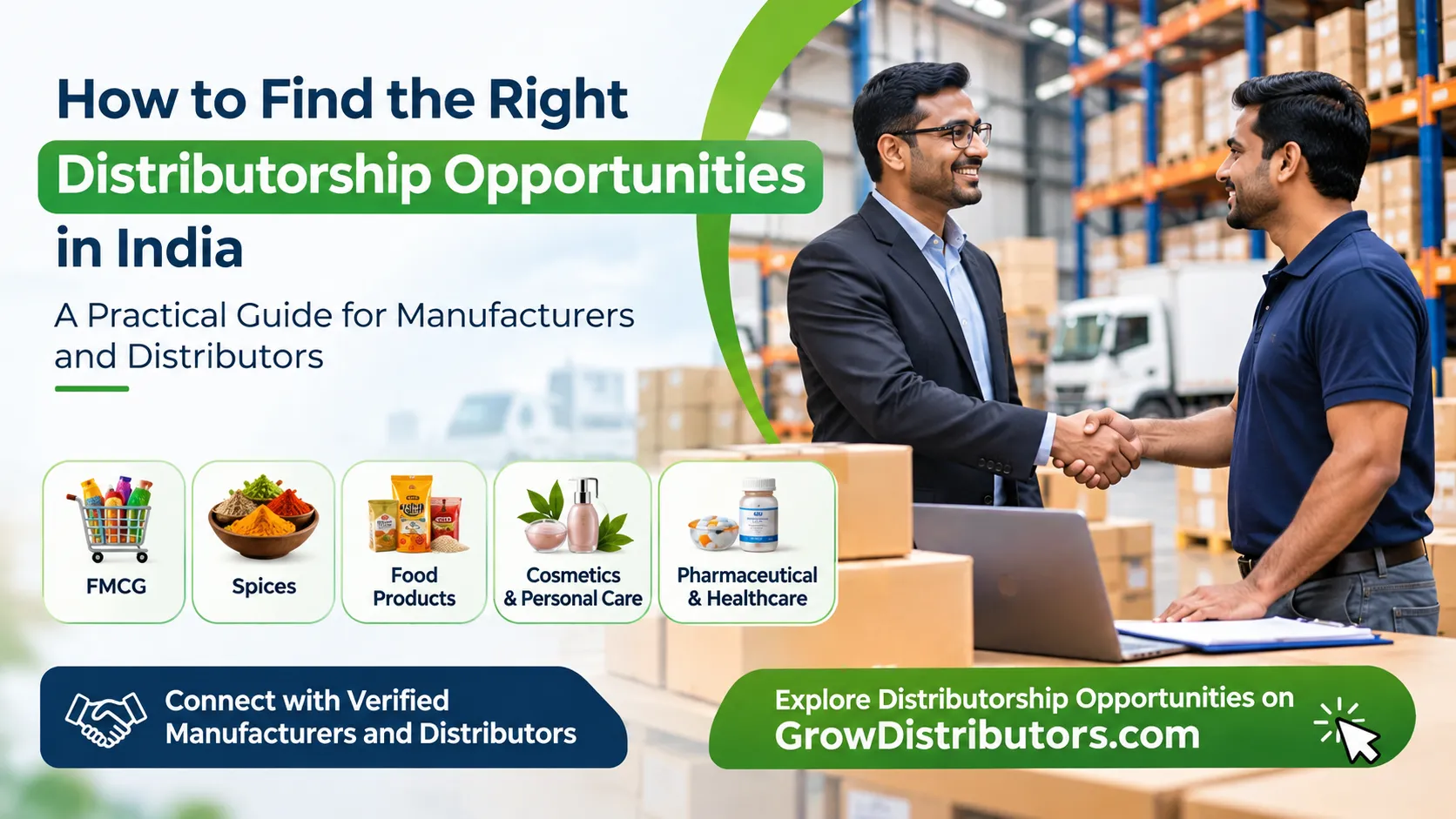
How to Find the Right Distributorship Opportunities in India: A Practical Guide for Manufacturers and Distributors
How to Find the Right Distributorship Opportunities in India: A Practical Guide for Manufacturers and Distributors
Every product on a shop shelf got there through a distribution chain. A manufacturer can make an excellent product, but without reliable partners in each region, it stays stuck in one market. That is why distributorship opportunities matter so much in India’s business landscape.
India’s markets are spread across states, languages, and buying habits. A brand that sells well in one city may be unknown a few hundred kilometers away. Manufacturers, emerging brands, FMCG companies, and wholesalers all need local partners who understand their territory. Aspiring distributors, on the other hand, want products with real demand and a manufacturer they can trust.
This guide explains how the distributor model works, which categories are open, how to judge an opportunity, and where B2B platforms fit in. It is written for both sides of the table.
What Are Distributorship Opportunities?
Distributorship opportunities are business arrangements in which a manufacturer or brand appoints a distributor to buy, stock, and sell its products in a defined area or channel. The distributor earns from the trade, and the manufacturer gains market reach without building its own network everywhere.
How the distributor business model works
The manufacturer produces goods and sets the terms: pricing, territory, supply schedule, and support. The distributor buys in bulk, stores the stock, and supplies it to wholesalers, retailers, or institutional buyers. Some distributors also handle collections, local promotions, and feedback from shops.
Why manufacturers appoint distributors
Setting up a direct sales force in every region is costly and slow. A good distributor already has shop relationships, storage space, delivery vehicles, and an understanding of local buying patterns. For a growing brand, that is a faster and safer way to enter new markets.
Why the partnership creates value for both sides
The manufacturer gets reach and steady sales. The distributor gets a product line to build a business around. When both sides are honest about expectations, the relationship can last for many years. When they are not, it usually falls apart within a season.
Why Are Distributorship Business Opportunities Growing?
Distributorship business opportunities are growing because more brands are trying to reach more places, and they need local partners to do it. Several forces are behind this.
- FMCG brands keep widening their presence beyond big cities into smaller towns and semi-urban markets.
- Regional demand has become stronger, so brands want partners who know each district personally.
- Emerging brands in food, spices, cosmetics, healthcare, and household goods are launching products faster than before.
- Retailers prefer dependable suppliers, which pushes brands to build organized supply chains.
- Manufacturers now look for verified, serious partners instead of relying only on personal contacts.
The last point deserves attention. Many manufacturer-distributor deals used to depend on references and chance meetings. That still happens, but organized B2B networking is slowly replacing luck with structure. Businesses want to find each other directly and compare options before committing.
What Types of Distributorship Opportunities Exist in India?
Opportunities exist across almost every consumer and industrial category. Here are the main ones, viewed from a business angle.
FMCG distributorship
Fast-moving consumer goods sell quickly and repeatedly, so stock rotates often. This category covers daily-use packaged items and suits distributors with strong retail connections.
Food products distributorship
Packaged snacks, staples, beverages, and ready-to-cook items fall here. Shelf life, storage conditions, and freshness handling matter a lot.
Spices and masalas are part of nearly every Indian kitchen. Branded packaging has opened room for regional brands to grow through wholesale and retail channels.
Cosmetics and personal care distributorship
Skincare, haircare, and grooming products depend on brand trust and retail visibility. Distributors need to manage product freshness and display support.
Pharmaceutical and healthcare distributorship
This category involves regulation, licensing, and careful storage. It suits distributors who can meet compliance requirements and maintain strict records.
Agricultural products distributorship
Seeds, inputs, produce, and related goods serve farmers and agri-traders. Seasonal demand and rural reach are the key factors here.
Household products distributorship
Cleaning supplies, kitchen goods, and home essentials are steady sellers through both wholesale and retail routes.
Electronics and consumer goods distributorship
Accessories, appliances, and gadgets need warranty handling, after-sales support, and a distributor who can manage returns without friction.
How Do You Find the Right Distributorship Opportunity?
Start with what you already know. The right opportunity matches your experience, your storage capacity, your customer base, and your ability to manage working capital. Here is a practical way to judge any opening.
- Pick an industry you understand. A distributor with strong grocery shop contacts will usually do better in food than in electronics.
- Study the manufacturer. Check how long the brand has operated, whether its products are available elsewhere, and whether it responds clearly to questions.
- Test product demand. Visit shops, talk to retailers, and ask what customers actually buy. Do not rely only on the manufacturer’s pitch.
- Read the distribution terms. Understand pricing structure, margins, payment cycles, return policies and minimum commitments before you agree to anything.
- Check supply chain strength. Ask how orders are fulfilled, how fast stock arrives and what happens when supply is delayed.
- Clarify territory. Know exactly which area is yours, and whether the manufacturer may appoint other distributors nearby.
- Think long term. Choose brands you can grow with, not brands that only look attractive this month.
Are you comparing two similar offers? Look at support, not just margin. A slightly lower margin with strong marketing help and reliable supply often beats a higher margin with neglect.
If you want to see what is currently open, you can explore distributorship opportunities [ADD INTERNAL LINK] listed on GrowDistributors.com.
Why Do Manufacturers Need a Strong Distributor Network?
Manufacturers need a strong distributor network because production alone does not create sales. Products must be available at the right place, at the right time, and backed by someone who knows the local market.
A reliable distributor network helps in these ways:
- Market expansion: new regions open up without heavy direct investment.
- Regional penetration: local distributors reach towns and neighborhoods that national teams often miss.
- Product availability: shelves stay stocked, which protects brand reputation.
- Supply chain efficiency: stock moves in planned flows instead of scattered shipments.
- Local relationships: distributors know which retailers pay on time and which products move fastest.
- Dependable partnerships: steady partners reduce the constant effort of finding replacements.
This is why a distributor network for manufacturers is treated as a core business asset rather than a side activity. It is also why you often see posts like “distributor wanted urgently” on business boards. Usually, it means a manufacturer has a product ready, or a territory has become vacant, and it needs a capable partner soon. Urgency is not a bad sign, but as a distributor, you should still slow down and check the terms. Speed on the manufacturer’s side should never rush you past your own due diligence.
For brands in this position, manufacturers looking for distributors have more options today than in the past. They can publish requirements, describe their products and territories, and invite serious applicants instead of searching blindly.
What Should You Know About FMCG Distributor Opportunities in India?
An FMCG distributor buys fast-moving consumer goods from a manufacturer and supplies them to retailers and wholesalers in a specific area. FMCG distributorship opportunities are popular because demand repeats. Customers buy these products again and again, so stock turns quickly.
Business potential
The business potential comes from volume and regularity rather than high prices. A distributor who keeps stock available, delivers on schedule, and builds retailer trust can create a stable business over time. Results, of course, vary with the brand, territory, and how well the distributor manages operations.
Product categories and retail connectivity
FMCG covers packaged foods, beverages, home care, personal care, and similar daily-use goods. Distributors usually connect with general stores, supermarkets, wholesalers, and sometimes institutions. Strong retail connectivity is the real asset in this business. Without it, even a popular brand struggles to move stock.
Choosing reliable FMCG brands
A famous name is not the only safe choice, and a new name is not automatically risky. What matters is product quality, clear pricing, steady supply and honest communication. Ask for details about how the brand supports its distributors, how it handles damaged or expired goods, and how it plans to promote the product in your area.
For those searching across this wider category, you can find business distribution opportunities and filter by product type.
What Are the Spices Distributorship Opportunities?
Spice distributorship means supplying branded or bulk spices and masalas to retail shops, wholesalers, and food businesses. It is a strong category because spices are used daily, and regional taste preferences keep demand varied and consistent.
Regional demand for spices
Taste differs across India. A masala blend that sells well in one region may need adjustment in another. Distributors who understand local preferences can guide manufacturers on which products fit their area.
Branded masala distribution
Packaged masalas have gradually grown beside loose spices. Branded products offer consistent flavour, hygienic packing and recognisable identity, which retailers value. Distributors can help new masala brands gain shelf space by building trust with shopkeepers.
Retail and wholesale networks
Spices move through kirana stores, supermarkets, wholesalers, caterers and food processors. Each channel has different buying patterns. Retail needs smaller packs and attractive display. Wholesale and institutional buyers care more about volume, price and delivery timing.
Product quality and consistency
In spices, quality is everything. Aroma, colour, purity and freshness decide whether a customer returns. A distributor should check samples, ask about sourcing and storage practices, and confirm the product stays consistent across batches. One bad batch can damage a retailer’s trust in you, not only in the brand.
Market expansion
Brands that start in one state often look for distributors elsewhere once they stabilise. That creates room for new partners, especially those with wholesale experience. If you want to enter this category, read more on spices distributorship opportunities
How Do B2B Distributor Platforms Help Businesses?
B2B distributor platforms are online spaces where manufacturers and distributors find each other, share requirements and start conversations. They replace scattered searching with one organized place to look.
A good distributor portal can help in these ways:
- Connecting manufacturers with distributors across different regions.
- Showing distributors the distributorship opportunities that are currently open.
- Helping brands extend their distribution network beyond their usual circle.
- Giving businesses more visibility among relevant buyers and partners.
- Making it easier to find distribution partners that match a specific product or territory.
You will often see phrases like “fastest growing distributor portal” or “fastest growing distributor platform” used in searches and advertising. Treat such phrases carefully. Growth is something you should verify yourself. Look at how active the platform is, how clear its listings are, whether real businesses are using it, and whether enquiries get genuine responses. A growing distributor platform proves itself through usefulness, not through slogans.
Why Is GrowDistributors.com a Useful Platform for Distributor Discovery?
GrowDistributors.com is a B2B platform designed to help manufacturers, brands and distributors discover relevant business opportunities and establish distribution connections. It works as a dedicated business networking environment for the distribution ecosystem.
Its purpose can be understood in simple terms:
- Manufacturers and brands can showcase what they make and describe the kind of distributors they need.
- Distributors can discover opportunities that match their interests, location and experience.
- Both sides can start manufacturer and distributor connections without long searches or middlemen.
- Businesses gain visibility within a space built for distribution, not general browsing.
- Distributor discovery becomes more accessible for smaller brands and new entrants.
It is worth being clear about what a platform can and cannot do. A platform introduces you to potential partners. It does not replace your own checks. Whichever route you take, verify the other party, read the terms carefully and discuss expectations openly before signing anything.
If you are a brand, you can list your products and requirements through the manufacturer registration page . If you are a distributor, you can start from the distributor registration page to explore relevant listings.
What Mistakes Should You Avoid When Choosing Distributorship Opportunities?
Many distributors lose money because of avoidable decisions. Watch out for these.
- Choosing a product without market research. A product that looks promising on paper may have little demand in your area.
- Ignoring manufacturer credibility. Check the company’s background, product quality and how it has treated other partners.
- Overlooking distribution conditions. Hidden clauses on payment cycles, returns, stock commitments or exclusivity can hurt later.
- Not understanding territory requirements. Unclear boundaries lead to disputes with other distributors or the brand itself.
- Underestimating logistics. Storage space, transport and delivery timing can make or break your margins.
- Skipping local demand checks. Even a good brand struggles if local customers prefer something else.
- Letting urgency drive decisions. A deal that must be signed immediately deserves extra questions, not fewer.
Manufacturers make mistakes too. Appointing too many distributors in one area, offering weak support, or choosing partners only on price can harm the brand. Good partnerships need effort from both sides.
What Is the Future of Distributorship Opportunities in India?
The future looks organized, connected and more transparent. Several trends are shaping it.
- Digital B2B platforms will keep making discovery easier, so partnerships will depend less on personal introductions alone.
- Regional distribution will gain importance as brands move deeper into smaller markets.
- Emerging brands will continue to enter food, spices, personal care and household categories, creating fresh openings.
- Supply chains will become more planned, with better tracking and clearer delivery expectations.
- Manufacturer-distributor relationships will lean toward long-term cooperation, with shared planning and open communication.
Distributors who adapt, keep their records clean and stay close to their customers will be better placed. Manufacturers who treat distributors as partners instead of order-takers will build stronger networks.
Final Thoughts: Choosing the Right Distribution Partnership
The right distributorship opportunity is not simply the one with the biggest brand or the most attractive margin. It is the one where product demand, manufacturer trust, clear terms and your own capacity all line up. Rushing, skipping research or ignoring conditions usually costs more than patience ever would.
For manufacturers, a dependable distributor network is a foundation for growth, not an afterthought. For distributors, a careful choice today shapes the business you run for years.
Whether you are a brand searching for partners or a distributor ready to explore new distributorship opportunities , GrowDistributors.com gives you a place to begin those conversations. Visit the platform, review what is available and start connecting with the right people.
Frequently Asked Questions
What are distributorship opportunities?
Distributorship opportunities are business openings where a manufacturer or brand appoints a distributor to stock and sell its products in a set area or channel. The distributor earns through trade, and the manufacturer expands its reach.
How can I find the right distributorship opportunities in India?
Start with an industry you understand, then research the manufacturer, product demand, margins, territory and supply terms. Compare more than one offer, speak with retailers, and use B2B platforms to see current listings before deciding.
Which industries offer FMCG distributorship opportunities?
FMCG distributorship opportunities usually appear in packaged food, beverages, spices, personal care, home care and household essentials. Any category with frequent, repeat purchases fits this model.
How can I find manufacturers looking for distributors?
You can browse B2B distributor platforms, attend trade exhibitions, contact brands directly and ask existing retailers which products they want to stock. Platforms like GrowDistributors.com let you discover manufacturers looking for distributors in one place.
What does distributor wanted urgently mean?
It means a manufacturer or brand needs a distributor quickly, often because a territory is open or a product is ready to launch. Treat it as an invitation to enquire, not a reason to skip your usual checks on terms and credibility.
How can manufacturers build a strong distributor network?
Manufacturers should choose partners based on market knowledge and reliability, set clear territory and payment terms, offer steady supply and support, and communicate openly. Listing requirements on a B2B platform can widen the pool of suitable candidates.
What is an FMCG distributor?
An FMCG distributor buys fast-moving consumer goods from manufacturers and supplies them to wholesalers and retailers in a defined area. The role includes storage, delivery and maintaining retailer relationships.
How can I start a spices distributorship business?
Begin by studying local demand, identifying reputable spice and masala manufacturers, checking product quality, and clarifying terms. Arrange suitable storage, build relationships with retailers and wholesalers, and confirm any required licences for food handling in your area.
What is the role of a distributor portal?
A distributor portal connects manufacturers and distributors in one online space. It helps businesses publish requirements, discover opportunities, improve visibility and find relevant distribution partners.
How do B2B platforms help manufacturers find distributors?
They let manufacturers describe products and territories, and let interested distributors respond directly. This reduces blind searching, widens reach and makes it easier to compare potential partners.
Where can businesses explore new distributorship opportunities?
Businesses can explore opportunities on dedicated B2B platforms, through trade events, industry associations and direct brand outreach. GrowDistributors.com is one place designed for this purpose.
Why is GrowDistributors.com useful for manufacturers and distributors?
It is a B2B platform built to help manufacturers and brands present their distribution needs, and help distributors discover relevant opportunities. It supports direct connections and improves visibility within the distribution ecosystem.