
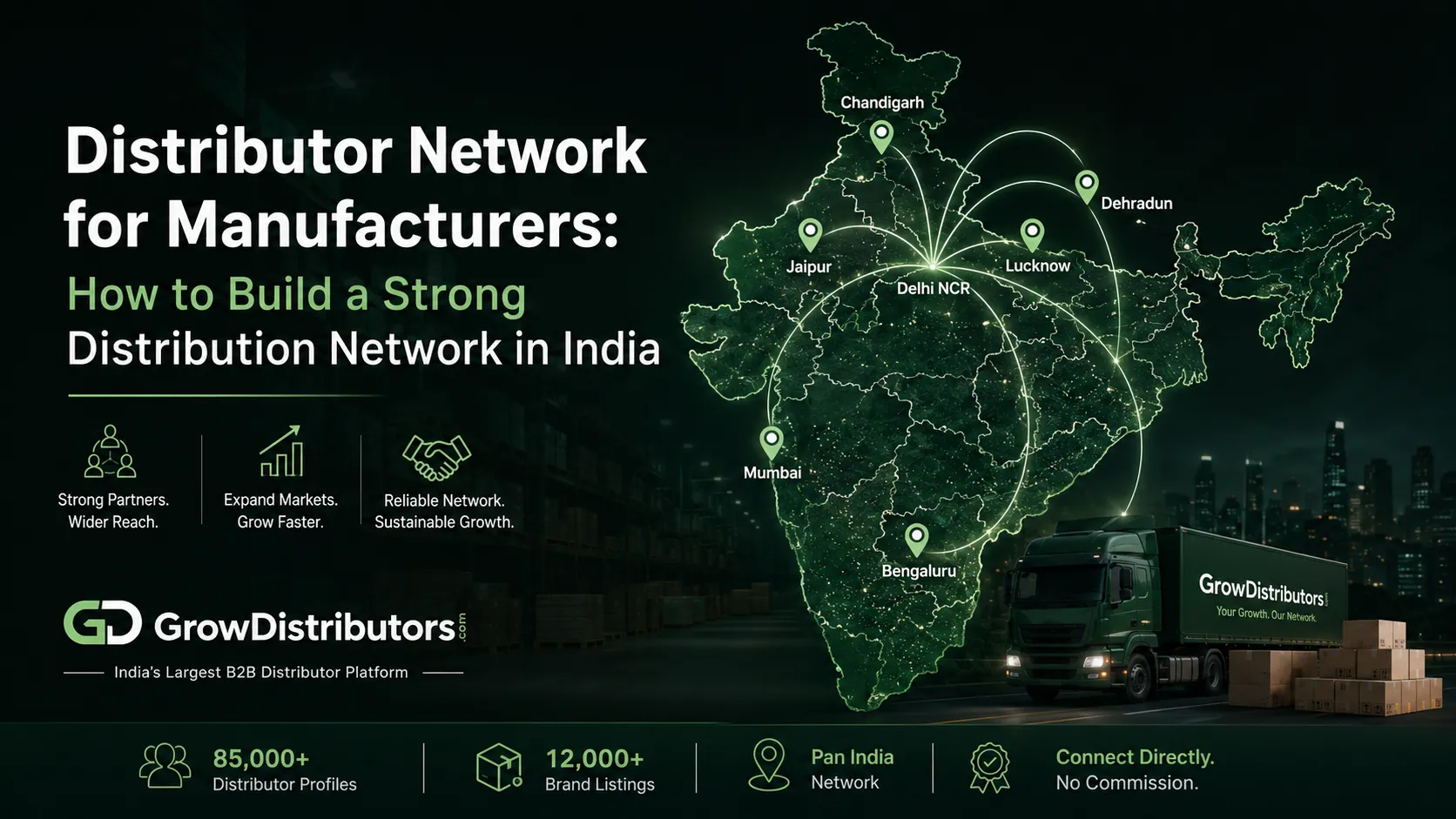
Distributor Network for Manufacturers in India | GrowDistributors
Distributor Network for Manufacturers: How to Build a Strong Distribution Network in India
For a manufacturer, producing a good product is only the first step. The bigger challenge is getting that product into the hands of retailers, dealers and customers across different cities and markets.
This is where a strong distributor network for manufacturers becomes extremely important.
Whether you are launching a new FMCG product, an Ayurvedic brand, an agricultural product, a home-care item, or a consumer electronic, the right distribution partners can help you enter new markets much faster. In fact, distribution is not simply about moving products from a factory to a shop. It is about building reliable local partnerships that can generate repeat orders and long-term sales.
What Is a Distributor Network for Manufacturers?
A distributor network is a group of distributors, dealers, wholesalers, super-stockists, and other channel partners who help a manufacturer sell and distribute products in specific markets.
Instead of trying to reach every retailer directly, a manufacturer can appoint suitable partners for different locations.
For example, a food manufacturer based in Delhi may appoint distributors in:
- Delhi NCR
- Jaipur
- Lucknow
- Chandigarh
- Dehradun
- Mumbai
- Bengaluru
Each distributor can manage retailers and customers within an assigned territory.
This model allows manufacturers to expand their market presence without building a large sales and logistics team in every city.
India's distribution ecosystem is particularly important for FMCG because the country has a highly fragmented retail market, with millions of traditional retail outlets.
Why Do Manufacturers Need a Strong Distribution Network?
A product can have excellent quality and pricing, but if customers cannot find it, sales will remain limited.
A strong distribution network helps manufacturers with:
- Wider market reach: Enter new cities and states through local partners.
- Faster product availability: Distributors maintain stock closer to retailers.
- Lower expansion costs: Manufacturers don't need to establish their own operations everywhere.
- Better local knowledge: Distributors understand local retailers, customers and buying patterns.
- Repeat sales: Established distributors can maintain regular retailer relationships.
- Faster new-product launches: Local partners can introduce new products to their existing network.
This becomes even more important when distributors required for new products is a priority. A new product needs more than initial marketing—it needs consistent availability in the market.
What Types of Businesses Can Build Distributor Networks?
Distributor opportunities are available across a wide range of industries. Some of the major categories include:
1. FMCG
FMCG remains one of the most active distribution categories. Manufacturers of snacks, beverages, spices, packaged foods, personal-care products and household items regularly look for channel partners.
Businesses searching for an FMCG distributor wanted can benefit from identifying partners with existing retailer networks and suitable storage facilities.
2. Food & Beverage
This includes:
- Snacks and namkeen
- Tea and coffee
- Spices and masalas
- Packaged foods
- Beverages
- Dairy products
- Biscuits and confectionery
- Organic and health foods
3. Health, Personal Care & Ayurvedic Products
Demand for personal care, herbal, and wellness products has created opportunities for manufacturers and distributors alike.
Products can include cosmetics, skincare, haircare, soaps, Ayurvedic products, herbal supplements, and oral-care products.
4. Agriculture & Farming
Agricultural machinery, seeds, fertilizers, pesticides, irrigation equipment, farming tools and animal-feed products can use regional distribution networks to reach dealers and farmers.
5. Home Care & Cleaning
Detergents, disinfectants, toilet cleaners, kitchen cleaners, air fresheners and cleaning equipment are other categories where distributors can play a major role.
6. Apparel, Electronics, Construction & Industrial Products
Distribution is not limited to consumer goods. Apparel, footwear, electronics, electrical products, building materials, machinery and industrial supplies can also use distributors and dealers for market expansion.
Platforms such as GrowDistributors list opportunities across categories including Food & Beverage, Health & Personal Care, Ayurvedic & Herbal Products, Home Care, Apparel, Agriculture, Building & Construction, Pharmaceuticals, Electronics and several industrial categories.
How Can Manufacturers Find the Right Distributor?
Finding a distributor is easy. Finding the right distributor is the real challenge.
Before appointing someone, manufacturers should evaluate:
- Market coverage – Does the distributor already operate in your target city or region?
- Retailer network – How many active retailers or dealers does the partner serve?
- Investment capacity – Can they maintain the required inventory?
- Storage and logistics – Do they have suitable warehouse and delivery arrangements?
- Product experience – Have they handled similar products before?
- Sales capability – Do they have salespeople or field representatives?
- Financial reliability – Can they manage working capital and payments?
- Growth mindset – Are they interested in building the brand rather than simply moving stock?
A good distributor should be treated as a business partner, not simply another customer.
How GrowDistributors Can Help Manufacturers
Finding suitable partners manually can take considerable time. This is where GrowDistributors can make the process easier.
GrowDistributors provides a B2B platform where manufacturers and brands can post their distribution requirements and connect with distributors, dealers and super-stockists across India.
According to the platform, manufacturers can access 85,000+ distributor profiles, post unlimited opportunities and connect directly without commission. It also states that its network includes 12,000+ brand listings and allows users to filter opportunities by location and investment.
For a manufacturer looking for distributor needed or distributors required for new products, a platform like this can simplify the initial discovery process.
Key points manufacturers can consider:
- Post a clear distribution requirement.
- Specify the target city or state.
- Mention expected investment.
- Clearly explain product categories.
- Provide expected margins where appropriate.
- Define territory and distribution requirements.
- Evaluate potential partners before signing an agreement.
For someone who wants to became a distributor, such platforms can also provide access to multiple brands looking for distribution partners.
How to Build a Distribution Network That Actually Works
Getting distributors onboarded is only the beginning.
Manufacturers should continuously support their partners through:
- Product training
- Marketing materials
- Competitive margins
- Sales incentives
- Regular communication
- Stock and demand planning
- Promotional campaigns
- New-product information
- Territory-specific sales strategies
Manufacturers should also monitor metrics such as sales by territory, active retailers, repeat orders, inventory movement and distributor performance.
A smaller network of productive distributors can often be more valuable than a large network where partners are inactive.
Frequently Asked Questions
1. How can I find distributors required for new products?
Manufacturers can search through B2B distributor platforms, industry networks, trade events and local business associations. Online platforms such as GrowDistributors can help manufacturers publish requirements and discover potential distribution partners across different locations.
2. What are the best distributorship opportunities in India?
Opportunities exist across FMCG, food and beverages, agriculture, healthcare, personal care, Ayurvedic products, home care, apparel, electronics, construction, and industrial products. The best opportunity depends on market demand, investment, margins, and the manufacturer's support system.
3. How do I become a distributor?
To become a distributor, identify suitable brands, understand their investment and territory requirements, check expected margins, arrange the necessary working capital, and contact the manufacturer or platform listing the opportunity.
4. What should manufacturers check before appointing a distributor?
Manufacturers should check the distributor's territory coverage, retailer network, financial capacity, warehouse facilities, logistics, sales team, and experience with similar products.
5. Is FMCG distribution a good business opportunity?
FMCG can offer attractive distribution opportunities because products are purchased frequently and require continuous replenishment. However, profitability depends on factors such as product demand, margins, inventory turnover, competition, territory and operating costs.
Final Thoughts
Building a successful distributor network for manufacturers is ultimately about finding the right combination of people, markets and products.
Manufacturers should not focus only on appointing as many distributors as possible. Instead, the goal should be to develop reliable partners who can consistently stock products, reach retailers, and grow sales in their territories.
For brands searching for new partners and for entrepreneurs exploring distributor opportunities or wanted distributorship in India, digital B2B platforms can make the discovery process considerably easier.
A strong product gets you into the market. A strong distribution network helps you stay there and grow.


